
There Might Be Sharks
WORKING WITH PERSPECTIVE TAKING & FEAR
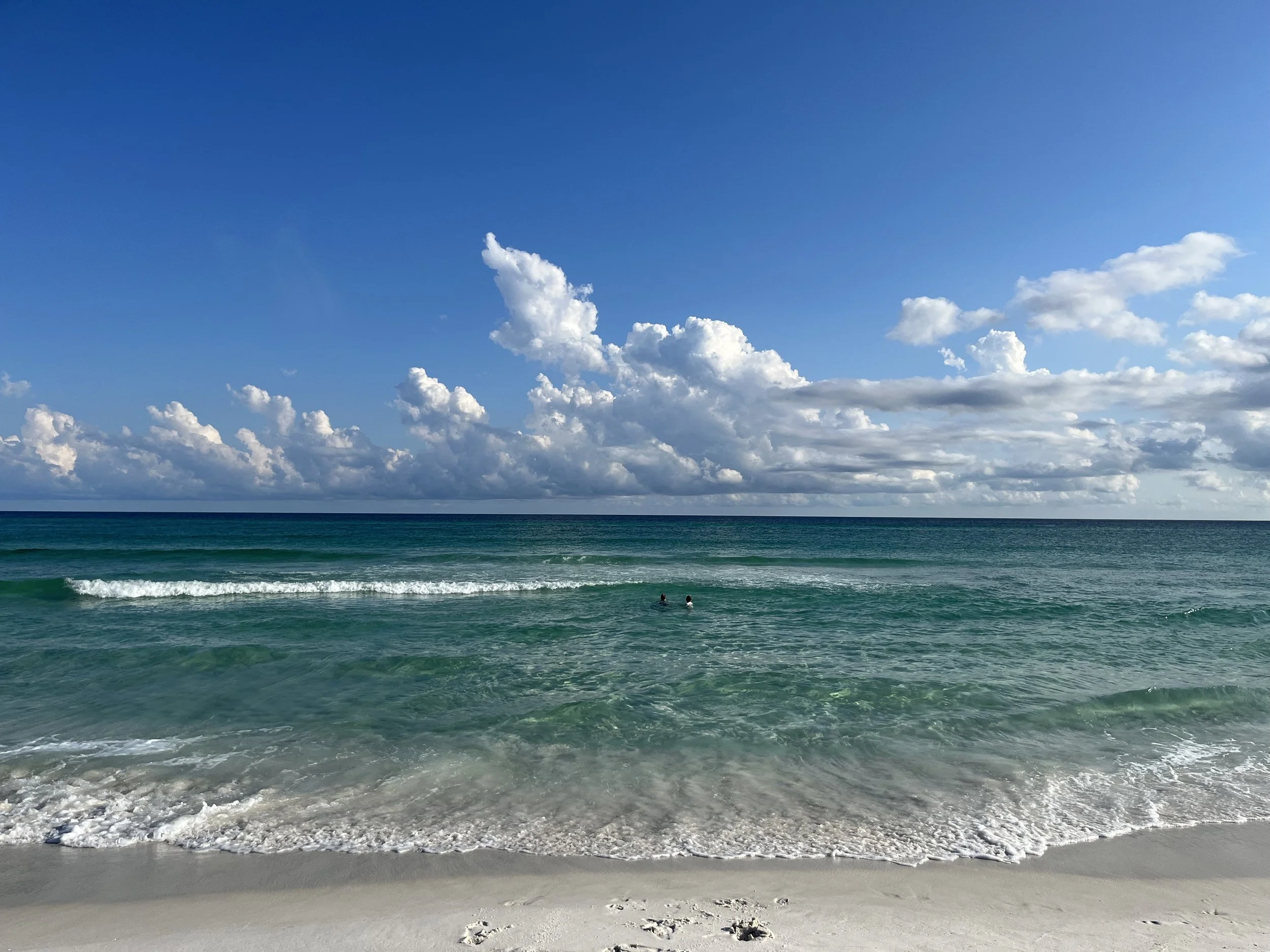
Don't give in to your fears. If you do, you won't be able to talk to your heart.
PAULO COELHO
Have you ever been faced with a known risk that invited an inquiry into the line between love and fear? How do we recognize the difference between responding to a genuine risk and responding to old pain, old stories, or a nervous system that simply wants certainty? This post examines this very human moment.
Story
I'm standing in my happy place. My feet sink slowly into warm white sand, my toes gripping as foaming waves rush over them. I hear the familiar sounds of windblown dunes, the trill of sandpipers, children laughing and squealing with wonder, and, of course, the rhythmic lull of the waves calling to the exhausted parts of modern life like a siren song. I breathe deeply, inhaling the salt air as the vast horizon greets me in our yearly ritual. The Gulf is an old friend, a deep comfort, and yet, even after that familiar hello of gratitude, I find myself settling back into another familiar role.
Protector.
There is a little compartment of my mind that has existed ever since I gave birth to a child. It's the part of me that quietly scans any space I walk into for apparent danger. I can be standing in one of the most beautiful places on earth, surrounded by emerald water with ribbons of sunlight dancing beneath the surface, soaking up the peaceful moment with my husband and son laughing fifteen feet away from me, and still have a low-level scan doing its job. Somewhere beneath the awe, the surrender, and the connection to nature, that quiet part is scanning the horizon, voice asking,
Are there sharks?
On our first day at the beach, I looked out past the first sandbar into the current of deep sapphire choppy water and noticed something sleek and black launch into the air, twisting into the most magnificent tight spin before disappearing beneath the water again. Having spent years in California watching dolphins swim alongside me as I walked the shoreline, I confidently announced, "There are dolphins here!"
My family came running into the water with me.
We spent the next hour swimming, laughing, jumping waves, blissfully unaware that those were, in fact, not dolphins.
In our fun, I heard someone calling kindly from the nearby shore. A lifeguard was stopped on his ATV, smiling and making a friendly upside-down V with his hands, motioning to get out. I got out of the water, stating, “Yes, we saw the dolphins.”
Nope.
He was trying not to induce panic and waved for everyone to come to shore. When we gathered, he announced that “hundreds of spinner sharks” were migrating through the area and everyone should simply swim at their own risk. Apparently this stretch of coastline becomes a migration channel every year. It is the most ordinary thing in the world. Animals migrate. Sharks pass through these waters because that's what sharks do. They're not thinking like humans. They're certainly not trying to terrify beachgoers. They're simply following their seasonal primal patterns, and chasing a food source (to be clear…schools of fish).
We calmly walked to our beach chairs and settled into a snack, then I realized! Instead of the wave of panic I might normally expect after hearing news like this, I found myself filled with peace and curiosity. To be fair, earlier in the month I had the glorious benefit of a weeklong mindfulness retreat with my best friend. Nothing like endless time of curling up by a lake in the Hudson Valley to soften some of those ancient survival instincts. I found myself in awe of the whole scene. That shark was having some fun. How many millions of people enter the ocean every year? How many millions of sharks are out there? And how relatively few attacks occur.
And I don’t want to sound cavalier or dismissive. Shark attacks happen, and when they do, they are horrific. I think about those families often when I step into the ocean. I don't want to minimize that reality or become naïve simply because I love being in the water.
But I also don't want to stifle the joy of my family over what is, statistically, an incredibly low possibility. Being in the ocean, held by nature, is such a healing space for us. Every year, somewhere in those first moments, I drop beneath the surface in a quiet ritual of gratitude. For a few seconds, all I hear is the muffled stillness of the water. I release everything that no longer belongs in my life—the striving, the worry, the endless mental tabs left open—and when I rise back into the salt air, that first breath always feels like a small beginning.
My husband and son give me space for my little ritual, trying to patiently wait for me to jump in on the fun. They are already laughing, throwing a frisbee, daring each other into bigger waves, and inevitably inviting me into another hopeless game of monkey-in-the-middle. I will gladly be the monkey for the rest of my life if it means hearing those two laugh together. The ocean has become one of the places where our family remembers how to simply be together. That feels worth protecting, too.
All of this made me think about risk and perspective, and how humans hold the balance in order to create a life that feels good and meaningful. Risk for me moves back and forth depending on how much fear is living in my body that day or, if I'm being honest, what my hormones happen to be doing. I don't experience myself as someone who has reached a permanent accepting relationship with uncertainty. Instead, I find myself continually checking in and working with the impermanence and constant change of life.
Where am I today? What do I need?
Am I responding from wisdom?
Or from fear?
Later that afternoon I noticed a young mother and child wading through to the exact stretch of water where we had been swimming earlier. At almost the same moment, an older woman in a yellow swimsuit—the wife of a Navy officer, I later learned—went running into the surf yelling, "There are sharks!"
The young mother simply turned around and calmly replied, "Where? I don't see one."
I happened to be standing near her husband and older child, so I walked over thinking I should explain the commotion unfolding in the water. He simply smiled and shrugged. "We know," he said. "We've been coming here our whole lives. I grew up here fishing with my dad. There are always sharks in the ocean. That's where they live."
Then he said something that has stayed with me.
"My wife knows what to do. It's a risk we're willing to take. We don't want anyone terrifying our children."
Later in the afternoon, I found myself talking with the Navy couple, thanking the wife for warning us about the sharks. Her husband, a former SEAL, had commanded the several-beach-umbrella village of kids, grandkids, and close friends to stay out of the water. He told me of his fears and losses. Too many endured for him to survive one of his loved ones getting hurt. I could feel his heavy burden of wanting to protect them all. And they were respecting his need for peace and safety.
Over the next week, the spinner sharks moved through without incident. Our little stretch of shoreline became an interesting experiment in how families respond to risk. Some decided they weren't going anywhere near the water. Others happily swam all day. We landed somewhere in the middle, trying to be thoughtful about it while still enjoying the ocean. We respected the boundary of the sandbar, left our jewelry behind so it wouldn't catch the light, and got out whenever a school of fish decided to cozy up. Other than one lazy stingray drifting past, we managed to steer clear of the larger sea life.
I couldn't help but notice that we all had access to the very same information, yet we were making remarkably different decisions. None of them wrong.
For me, the week became a practice in noticing my own relationship with fear. Where do I allow it to guide me? Where does it offer wise information? And where is the boundary where it begins asking too much of my life?
I'm becoming increasingly interested in that distinction. How do I recognize the difference between responding to a genuine risk and responding to old pain, old stories, or a nervous system that simply wants certainty? I'm not looking for a winner or even a right way of being. I believe we are all doing the best we can with the information, experiences, and bodies we bring into any given moment.
If anything, getting older has made me feel less certain and more compassionate. Toward myself. Toward other people. We are all carrying histories that shape what we notice, what we fear, and what we choose. And I’m increasingly valuing how essential it is to pause, breathe, and simply ask the question - What part of my fear is a true concern to be managed, and what part is an old self working to protect? If I can drop in and feel my response, then I open up a wider lens of possibility - more choices, a deep understanding of my WHY, what values are involved, what the bigger goals are, what I actually need, or what my family really needs in that moment.
Cultivating that pause is so crucial for our long-term sanity. Because it's not just sharks that loom on the horizon. Sometimes it's a move. A new job. A marriage. Heartbreak. Boarding an airplane. An illness. An election season. (And yes, apparently even a national lettuce crisis.) Closer to home, it's my teenager growing up, soon learning to drive, followed far too quickly by college. Life keeps asking us to love deeply while knowing nothing is guaranteed.
So this summer offered me a new mantra, one that is not decisive, but a tool for discernment, for listening to my own heart. Even with all of these words exploring this space of risk and perspective, this might not make sense to anyone but me. Even still, when I feel the rise of risk in my body, and I need some space to reflect on right action, I whisper, “There might be sharks. And that might be ok.”
So grateful to be building a mindful life with you.
May you be well.
Shelly
Practice
Meditation by Tara Brach
Here is a lovely meditation on the heart by my go-to guided meditation teacher, Tara Brach.
Space for yourself to center and work with crossroads moments to find clarity and meaningful direction.
Follow me on Instagram for tips, resources, and musings on how to Build a Mindful Life.